

How RFID-on-Metal Tags Transform Asset Tracking in Tough Industries
Introduction
Tracking assets in harsh industrial environments is a constant challenge. Traditional RFID tags often fail when attached to metallic surfaces, leading to poor read rates and unreliable data. This limitation has long hindered industries that rely on metal-heavy equipment and infrastructure.
RFID-on-metal tags are designed to overcome these barriers, offering reliable tracking even in the toughest conditions.
What are RFID-on-Metal Tags?
RFID-on-metal tags are specialized RFID tags designed to work effectively on metallic surfaces where standard tags often fail. Unlike conventional tags, they incorporate shielding layers, strong adhesives, and durable casings that prevent signal interference and ensure consistent performance. These innovations make them highly resilient, allowing the tags to withstand extreme conditions such as heat, moisture, vibration, and chemical exposure. As a result, RFID-on-metal tags deliver reliable accuracy, adaptability across different industries, and long-term durability, making them a practical solution for asset tracking in challenging environments.
Challenges of Asset Tracking in Tough Industries
Industries such as oil & gas, manufacturing, and aerospace face unique tracking challenges:
- Metal interference: Standard RFID tags lose signal strength when attached directly to metallic surfaces.
- Harsh conditions: Heat, moisture, vibration, and chemical exposure often damage conventional RFID tags.
- High-value assets: Expensive equipment requires precise identification and reliable monitoring at all times.
How RFID-on-Metal Tags Overcome These Challenges
RFID-on-Metal tags are engineered to deliver consistent performance:
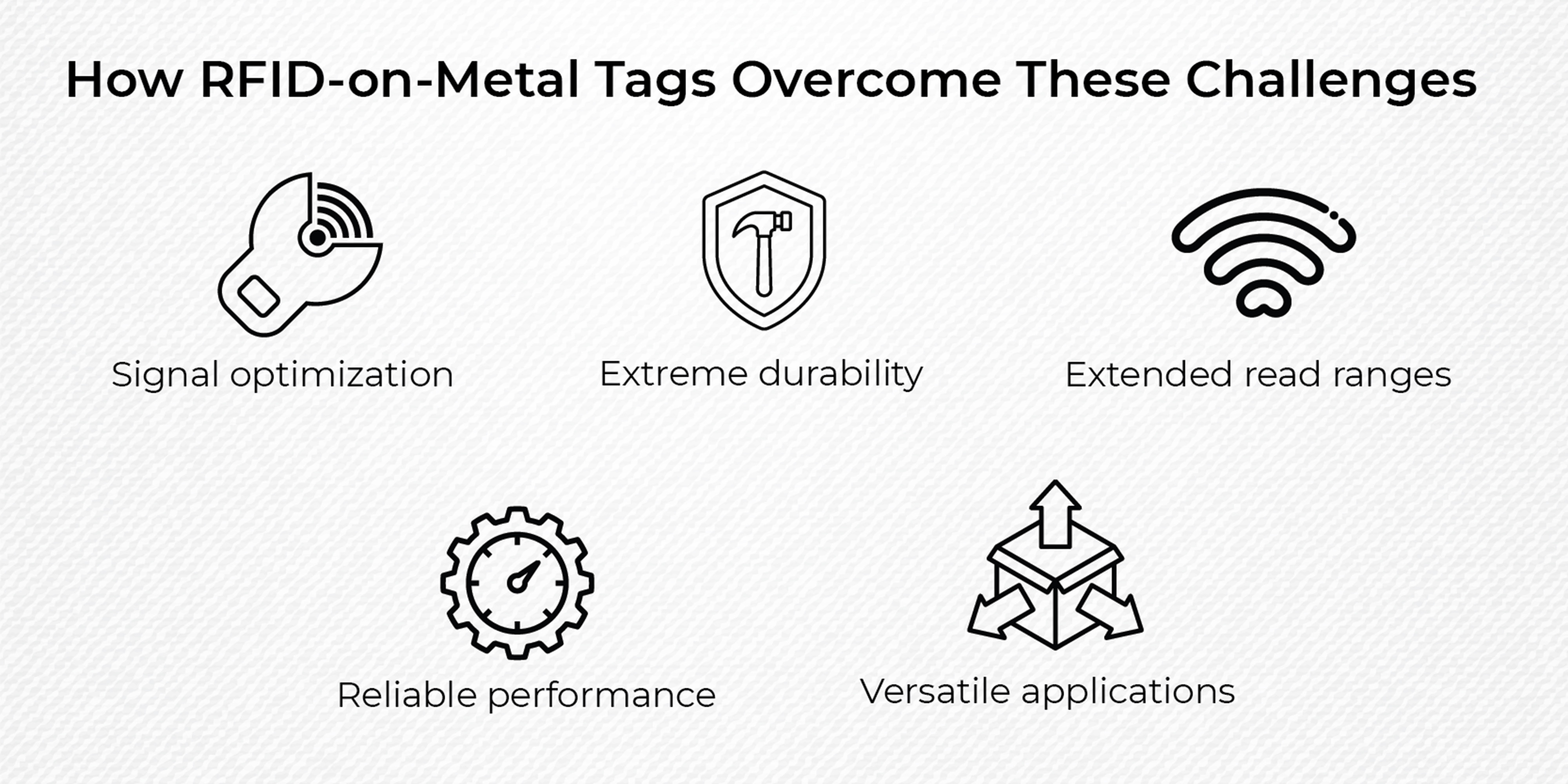
Signal optimization
Special shielding ensures strong read rates on metallic surfaces, reducing interference and improving data accuracy across industrial environments.
Extreme durability
Built to resist heat, moisture, vibration, and chemical exposure, these tags maintain performance even under harsh industrial conditions.
Extended read ranges
Longer read distances enable real-time visibility, allowing efficient monitoring of assets across large facilities and complex operations.
Reliable performance
Consistent tag readability ensures dependable asset identification, minimizing errors and supporting compliance with industry standards.
Versatile applications
Adaptable designs allow use across multiple industries, from oil and gas to aerospace, ensuring broad operational benefits.
Key Industry Applications of RFID-on-Metal Tags
Oil & Gas
RFID-on-Metal tags enable reliable tracking of pipes, valves, and drilling equipment in remote and hazardous sites, ensuring safety, reducing downtime, and improving asset visibility in environments where traditional tracking methods often fail.
Manufacturing
These tags help monitor tools, machinery, and spare parts with precision, enhancing production efficiency, reducing equipment misplacement, and supporting preventive maintenance programs critical for maintaining smooth operations in complex manufacturing facilities.
Construction
RFID-on-Metal tags provide accurate tracking of heavy equipment, steel structures, and site materials, improving project management, reducing theft or loss, and ensuring the timely availability of resources across large and dynamic construction sites.
Aerospace & Defense
By tagging critical components, RFID-on-Metal ensures compliance with strict safety standards, supports maintenance schedules, and enhances visibility of high-value assets essential for mission readiness and regulatory adherence in aerospace and defense industries.
Business Impact & ROI
Adopting RFID-on-metal tags delivers measurable benefits:
- Reduced asset loss and theft: Accurate tracking ensures assets are monitored continuously, minimizing misplacement, unauthorized use, and costly losses across industrial operations.
- Improved operational efficiency: Automated identification reduces manual work, speeds up asset audits, and streamlines workflows, allowing teams to focus on higher-value tasks.
- Regulatory compliance: Reliable tracking supports adherence to strict industry safety standards, ensuring audits are smoother and reducing risks of penalties or non-compliance.
- Cost savings: By minimizing manual processes, reducing errors, and preventing asset loss, RFID-on-metal tags deliver measurable financial benefits and long-term ROI.
How to Implement RFID-on-Metal Tags for Industrial Asset Tracking
Implementation requires a structured approach:
Assess needs
Begin by identifying which assets are most affected by metal interference, focusing on high-value equipment and critical components that require reliable tracking to ensure operational efficiency and compliance in demanding industrial environments.
Choose the right tags
Select RFID-on-metal tags specifically designed for your industry conditions, ensuring they can withstand environmental challenges such as heat, moisture, vibration, or chemical exposure while delivering consistent performance across different asset categories.
Integrate with systems
Connect RFID-on-Metal tags to existing RFID readers and asset management software, enabling seamless data flow, real-time visibility, and automated reporting that supports better decision-making and reduces manual tracking errors.
Pilot and scale
Start with a small deployment to measure tag performance and system integration, then gradually expand across operations to achieve full-scale implementation while minimizing risks and ensuring smooth adoption.
Train staff
Provide clear training for employees on how to use RFID systems effectively, ensuring proper tag placement, reader operation, and data interpretation to maximize the benefits of the technology.
Monitor and optimize
Continuously evaluate system performance, track ROI, and adjust deployment strategies to improve efficiency, reduce costs, and ensure long-term success in industrial asset tracking.
Conclusion
RFID-on-metal tags are transforming asset tracking in industries where reliability is non-negotiable. By overcoming the limitations of traditional RFID, they provide resilience, efficiency, and compliance in harsh environments.
For organizations managing tough assets, RFID-on-metal is not just a technology upgrade—it’s a strategic advantage.
Recent Posts
-

RFID in Linen Tracking
What Is RFID Linen Tracking? RFID linen tracking embeds durable RFID tags into textiles (sheets, to …Jul 12th 2026 -

How to Choose the Right RFID Reader for Shopify Retailers
Understanding RFID in Retail RFID technology (Radio Frequency Identification) allows retailers to tr …Jul 1st 2026 -
Streamlining Appliance Warehousing and Distribution with RFID
Introduction Warehousing appliances are tough because they’re bulky, fragile, and demand often spike …Jun 26th 2026