
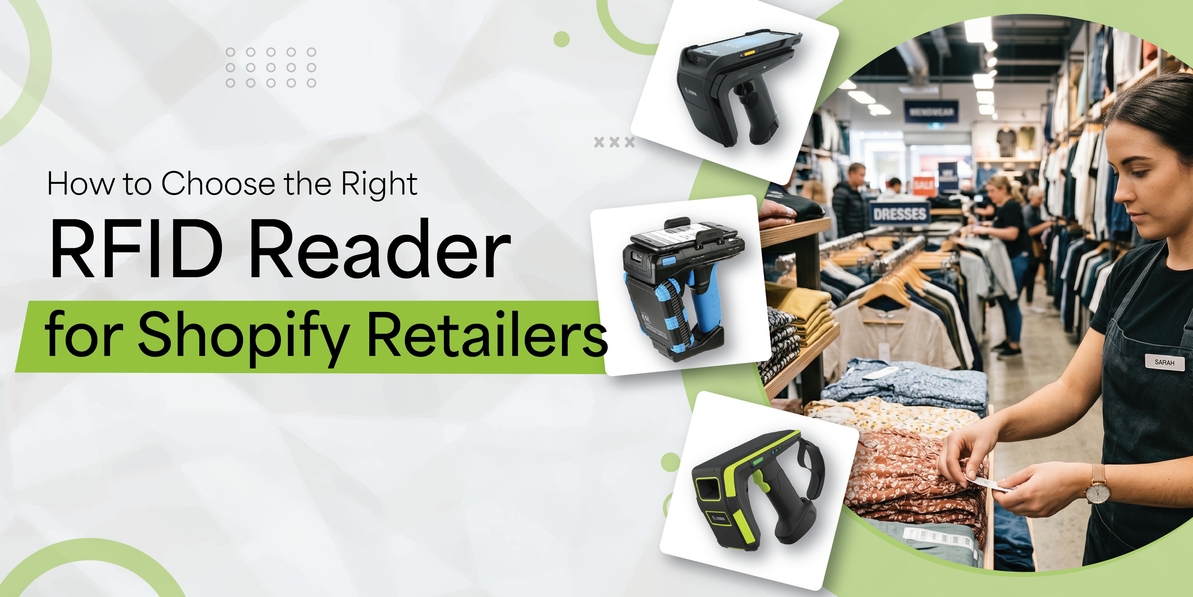
How to Choose the Right RFID Reader for Shopify Retailers
Understanding RFID in Retail
RFID technology (Radio Frequency Identification) allows retailers to track products using small smart labels that emit signals read by RFID readers. Unlike barcodes, RFID does not require line‑of‑sight scanning, meaning you can scan hundreds of items in seconds. For Shopify retailers, this translates into:
- Faster inventory counts.
- Real‑time stock visibility.
- Reduced shrinkage and misplacement.
- Improved customer experience with accurate product availability.
Traditional barcode scanning is labor-intensive and prone to human error, often resulting in inventory accuracy hovering around 60–80%. By switching to RFID, retailers typically see accuracy jump to 95–100%.
The core advantages for Shopify merchants include the following:
- Warp-Speed Audits: Handheld RFID readers can capture up to 1,000 labels per minute. What used to take a team three days can often be done by one person in a few hours.
- Real-Time Syncing: By integrating RFID readers with Shopify inventory management apps, stock levels update in real time, dramatically reducing stockouts and overselling on your e-commerce channels.
- Locating Missing Items: Many handheld readers feature a "Geiger counter" mode, using audio and visual cues to guide staff directly to a misplaced item on the sales floor or in the backroom.
Key Considerations for Shopify Retailers
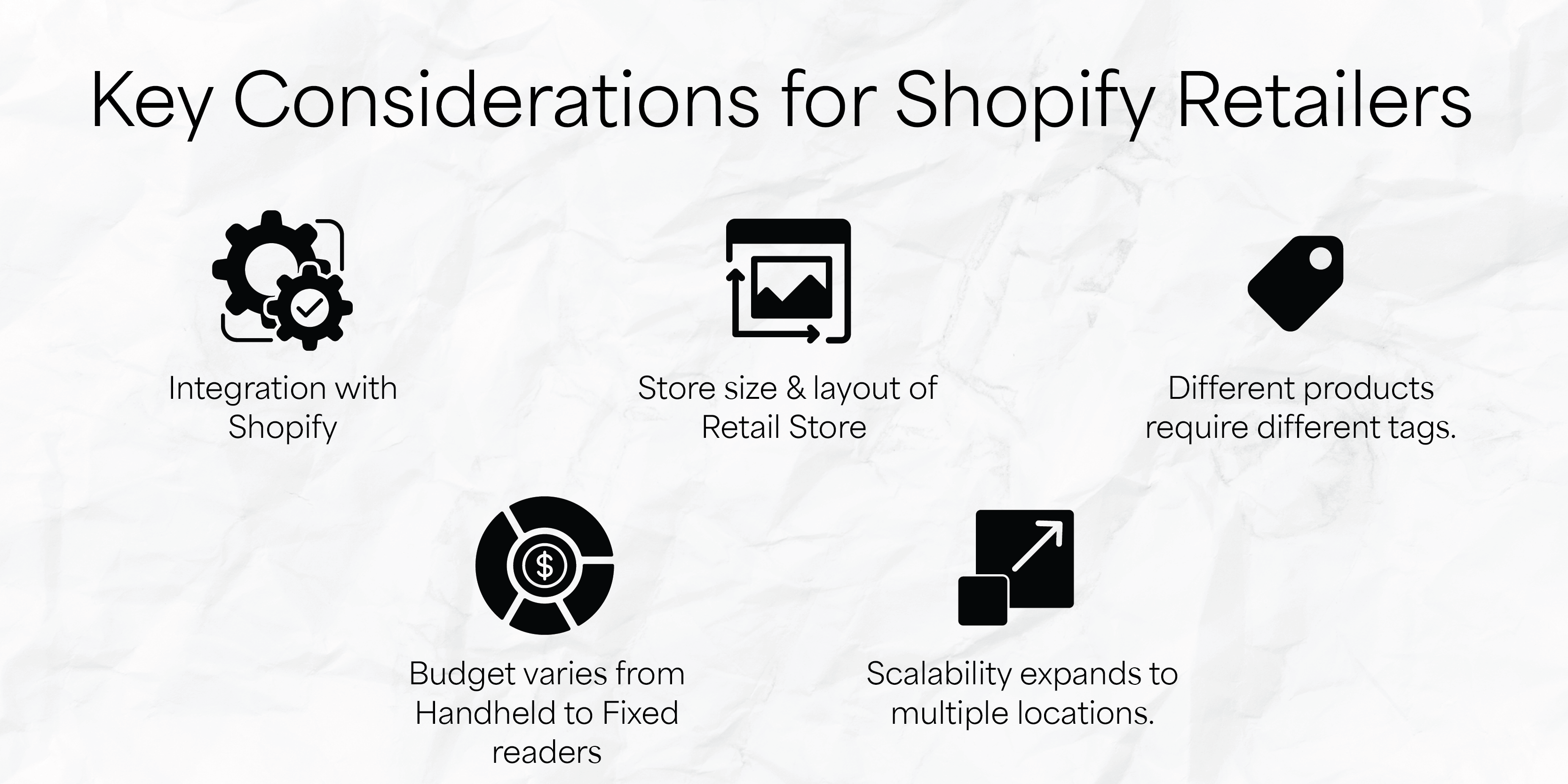
1. Integration with Shopify
Your RFID reader must connect seamlessly with Shopify’s ecosystem. This usually requires middleware or apps like Shopify or, which sync reader data with Shopify’s inventory system. Without integration, you’ll have isolated data that doesn’t update your online store, defeating the purpose of RFID.
2. Store size & layout
- Small boutiques: Handheld readers are sufficient. Staff can walk through the store and scan items quickly.
- Large stores or warehouses: Fixed readers with multiple antennas are better. They can continuously monitor stock movement at entrances, exits, or storage areas.
- Mixed environments: A hybrid approach works best — handhelds for audits, fixed readers for logistics.
3. Product type
Different products require different RFID labels and reader capabilities:
- Apparel: Standard passive RFID labels are fine.
- Electronics: May need specialized RFID labels to avoid interference.
- Liquids or metals: RFID signals can be distorted, so you’ll need high‑sensitivity readers or alternative tag placement strategies.
4. Budget
Costs vary widely: A handheld reader is generally less expensive than an RFID Fixed Reader.
RFID Labels: Passive RFID labels usually cost less than USD 10 cents each
- Retailers should calculate ROI based on reduced shrinkage, faster audits, and improved sales from accurate inventory.
5. Scalability
If you plan to expand to multiple locations, choose readers that support centralized management. Cloud‑based RFID platforms allow you to monitor inventory across all stores in real time, directly linked to Shopify.
2. Types of RFID Readers: Handheld vs. Fixed
Choosing the right reader depends heavily on what you are trying to track and where.
Handheld Sleds and Terminals
RFID handheld readers are the most common entry point for retail inventory management. They are either standalone mobile computers (like a smartphone with a built-in antenna) or "sleds" that attach to an existing iOS or Android device.
- Best for: Cycle counts, locating misplaced items, receiving purchase orders, and verifying outbound shipments.
- Examples: Zebra RFD40s, Zebra RFD90s, TSL Readers, and Chainway devices.
Fixed Readers and Portals
Fixed readers are mounted at specific chokepoints—such as receiving dock doors or the threshold between the backroom and the sales floor.
- Best for: Passive, automated tracking. When a pallet of tagged merchandise moves through a portal, the inventory is automatically received or transferred without an employee pulling a trigger.
- Drawbacks: Higher installation costs and more complex tuning to prevent "stray reads" (accidentally scanning items sitting too close to the door).
Key insight: Most mid-sized Shopify merchants start with 1-2 handheld sleds for weekly cycle counts before investing in fixed portals.
3. Software Bridge: Connecting RFID to Shopify
Shopify's native backend does not process raw RFID data directly. You need a middle layer—a specialized Shopify app—to translate the radio signals your reader captures into inventory adjustments.
|
TagMatiks RFID Connect |
End-to-end product tracking, seamless bulk scanning, automated cycle counting, and detailed analytics. |
High-volume stores (e.g., apparel, beauty) needing deep operational insights. |
These apps import your products, SKUs, and variants from Shopify. When you scan your sales floor, the app compares the physical count to your digital Shopify records and pushes the corrections back to your store.
4. Hardware and Shopify POS Compatibility
If you are using Shopify POS for in-person sales, you must ensure your hardware ecosystem plays nicely together. While your inventory audits happen via the RFID handhelds , TagMatiks retail, and Shopify POS apps, your checkout process relies on Shopify's supported hardware.
The Shopify POS Hub
TagMatiks Retail: Seamless POS Integration
The Retail Tech Ecosystem: Shopify vs. TagMatiks Retail. Before diving into the storefront operation, it is helpful to understand how your existing infrastructure connects to your physical store location:
- Shopify POS (The Brain): Shopify serves as your primary point of sale and system of record. It handles client profiles, captures transaction payments, processes receipts, and updates financial databases.
- TagMatiks Retail / RFID-APP (The Muscle): TagMatiks acts as your real-time physical inventory layer. Instead of reading standard barcodes one by one, it utilizes RFID (Radio Frequency Identification) technology. Every item in your store is bound to a completely unique digital identity called an EPC (Electronic Product Code), allowing the system to track individual stock items.
5. Choosing the Right RFID Labels
The reader is only half of the equation; the labels you choose dictate how well the system performs.
- Apparel and Soft Goods: Standard paper RFID labels (e.g., TT Paper RFID Labels) work perfectly. They are lightweight and can be easily integrated into existing hangtags.
- Liquids and Metals: Standard radio waves bounce off metal and are absorbed by water. If you sell cosmetics, beverages, or electronics, you must purchase specialized "on-metal" RFID tags that feature a buffer layer to prevent signal interference.
Recommended Approach
Pilot Program: Handheld Readers in One Store
- Workflow testing: Begin with handheld UHF RFID readers to validate scanning speed, tag readability, and staff adoption.
- Operational training: Train employees on scanning procedures, exception handling, and syncing data with Shopify POS.
- Controlled environment: Limit the pilot to one store to minimize disruption and allow focused troubleshooting.
- Baseline metrics: Record pre‑RFID shrinkage rates, inventory accuracy, and fulfillment speed for comparison.
Evaluate Shopify Apps & Middleware
- Integration middleware: Use solutions like TagMatiks RFID Connect to bridge handheld readers with Shopify’s inventory system.
- Compatibility testing: Ensure TagMatiks Connect RFID software supports real‑time sync, bulk uploads, and error reconciliation.
- Data flow validation: Confirm that scanned SKUs update Shopify inventory instantly, preventing phantom stock.
- Scalability check: Evaluate whether the app can handle expansion to multiple stores and warehouses.
Gradual Scaling Strategy
- Warehouse deployment: Add fixed readers at inbound/outbound docks to validate shipments and reduce supplier fraud.
- High‑volume locations: Install fixed readers in flagship stores or fulfillment centers where shrinkage risk is highest.
- Hybrid approach: Combine handheld readers for flexibility with fixed readers for automation.
- Phased rollout: Expand store by store, ensuring lessons learned from each deployment inform the next.
KPI Monitoring & Continuous Improvement
- Inventory accuracy: Measure SKU‑level accuracy before and after RFID deployment. Target >95%.
- Shrinkage reduction: Track theft, misplacement, and supplier fraud incidents.
- Order fulfillment speed: Monitor pick‑pack‑ship cycle times. RFID should reduce delays caused by stock discrepancies.
- Labor efficiency: Assess time saved in audits and cycle counts, reallocating staff to customer‑facing roles.
Conclusion
Choosing the right RFID reader for Shopify retailers is not just about hardware — it’s about integration, scalability, and operational fit. Handheld readers are ideal for small stores, while fixed readers suit larger operations. The ultimate goal is to create a seamless link between physical inventory and Shopify’s digital platform, ensuring customers always see accurate stock levels.
Recent Posts
-
Comprehensive Comparison of RFID Metal Mount Tags
RFID Metal Mount Tags are engineered to function reliably on metallic surfaces, where standard RFID …Sep 14th 2026 -
RFID Read Range Dropping? 5 Factors & Settings to Fix It
Introduction RFID technology is the backbone of modern retail and business operations. From tracking …Sep 7th 2026 -
Comprehensive Guide to Troubleshooting RFID Handheld Readers
RFID handheld readers are critical tools for inventory management, asset tracking, and logistics. Wh …Aug 19th 2026