

How RFID Helps Home & Garden Retailers Improve Sales
Introduction
Home & garden retailers operate in a highly competitive environment where seasonal demand, bulky inventory, and declining foot traffic create constant challenges. Customers expect products to be available when they need them, but managing stock across large stores and warehouses is complex. At the same time, rising competition from e-commerce has made efficiency and accuracy more important than ever. RFID (Radio Frequency Identification) has become a proven solution to address these issues, helping retailers streamline operations, reduce losses, and ultimately recover declining sales.
Understanding RFID Technology
RFID is a technology that uses radio waves to identify and track items automatically, without the need for line-of-sight scanning like barcodes. Each product is fitted with a small RFID tag that stores data, which is then captured by RFID readers placed in stores or warehouses. The collected information is processed through software platforms that integrate with point-of-sale and inventory systems, giving retailers real-time visibility of their stock. Unlike barcodes, RFID can scan multiple items at once and provide item-level accuracy, making it far more efficient. Its adoption is growing rapidly across retail sectors because it improves accuracy, reduces manual work, and supports automation — all critical for modern retail success.
Key Challenges Facing Home & Garden Retailers
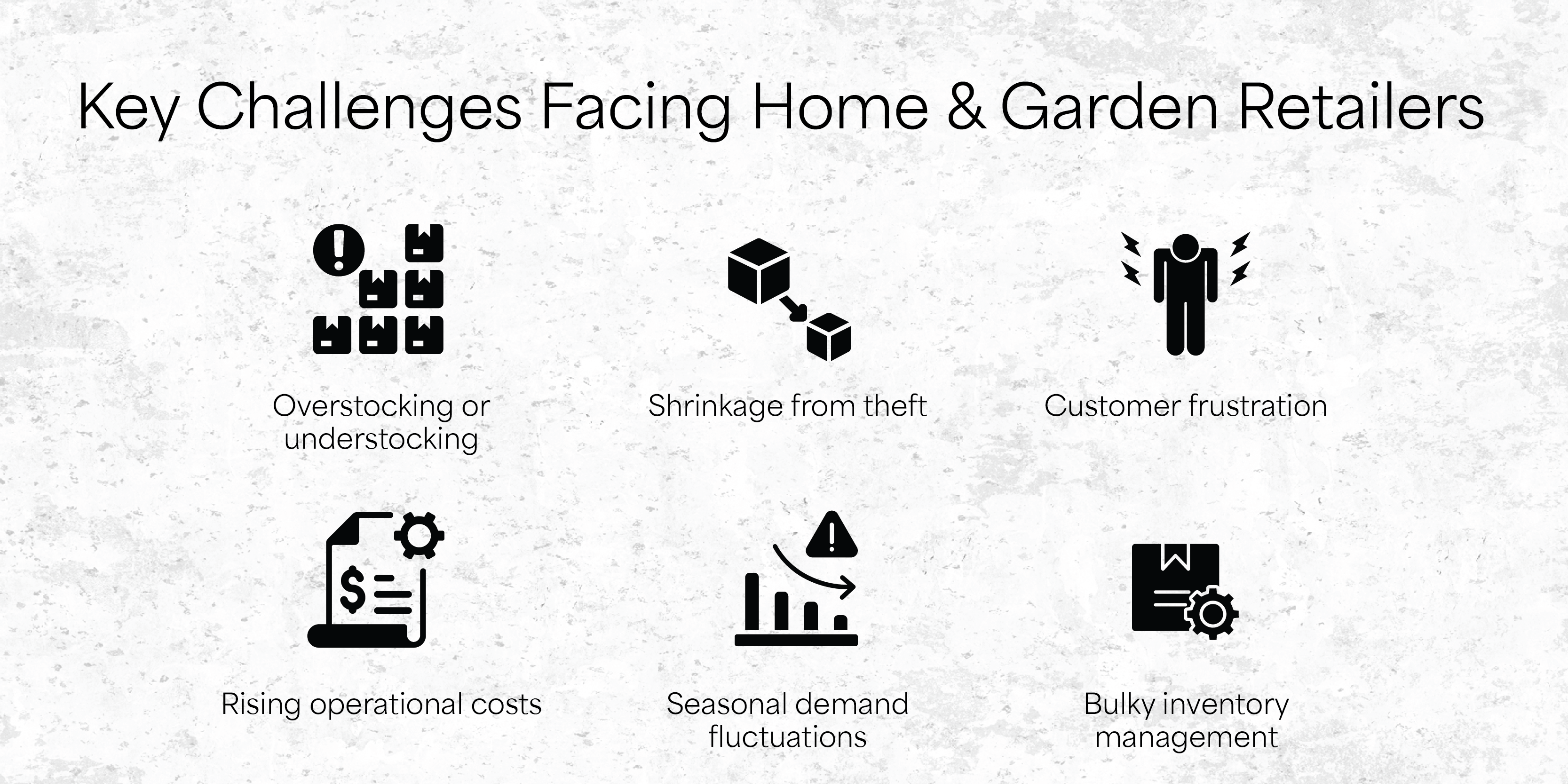
Overstocking or understocking occurs when demand forecasting is inaccurate, leading to wasted resources, lost sales, and poor customer satisfaction.
Shrinkage from theft or misplaced items reduces profit margins and creates gaps in inventory records, making operations less reliable.
Customer frustration grows when products are unavailable, damaging brand trust and pushing shoppers toward competitors.
Rising operational costs combined with e-commerce competition force retailers to find smarter ways to manage inventory and reduce expenses.
Seasonal demand fluctuations make planning difficult, often resulting in excess stock during off-seasons or shortages during peak demand.
Bulky inventory management challenges arise with furniture, plants, and outdoor equipment, which require more space and careful tracking.
Slow manual processes like stock counts and audits consume staff time, increasing labor costs and reducing efficiency.
Limited omnichannel integration prevents seamless customer experiences across online and offline channels, weakening competitiveness.
How RFID Addresses Inventory Accuracy
Inventory accuracy is one of the biggest challenges for home and garden retailers, especially when managing bulky or seasonal products. RFID technology provides real-time visibility across stores and warehouses, ensuring that stock levels are always up to date. By tracking items individually, retailers can monitor movement more effectively and avoid errors that often occur with manual processes. This improved visibility also strengthens forecasting and replenishment cycles, helping retailers maintain the right balance of products throughout the year.
Reducing Shrinkage and Loss Prevention
Shrinkage is a major issue for home and garden retailers, often caused by theft, misplacement, or mislabeling. RFID helps detect these problems quickly, builds trust in inventory data, reduces losses, and directly improves profit margins while supporting long-term operational stability.
Enhancing Customer Experience
Customer satisfaction depends on product availability and smooth shopping experiences. RFID ensures accurate stock across in-store, online, and curbside pickup channels. It speeds up checkout with bulk scanning and enables omnichannel strategies like Buy Online, Pick Up In Store (BOPIS), which customers increasingly expect.
Operational Efficiency and Cost Savings
RFID improves operational efficiency by cutting manual labor and reducing costly errors. It streamlines supply chain and logistics processes, ensuring smoother product movement. Retailers can begin with a pilot program and scale across categories, achieving measurable cost savings and long-term efficiency gains.
TagMatiks Retail
TagMatiks Retail is a specialized RFID solution designed to simplify inventory management for retailers. It enables businesses to generate and print RAIN RFID labels, conduct fast cycle counts, and reconcile discrepancies with accuracy. The platform also supports customizable reporting, mobile-friendly applications, and integration with various UHF RFID devices, making it ideal for managing bulky or seasonal home and garden products.
For Shopify retailers, TagMatiks Retail works seamlessly with Shopify through apps like TagMatiks RFID Connect, allowing them to fetch products, print RFID labels, and sync updated inventory data directly back to their online store. This integration ensures real-time visibility and reduces errors across both physical and digital channels.
Case Examples in Home & Garden Retail
Garden centers use RFID to track plants individually, reducing waste and ensuring accurate stock levels for seasonal items like flowers, shrubs, and gardening supplies.
Furniture retailers improve inventory accuracy and reduce shrinkage in high-value items such as outdoor furniture, décor, and equipment, protecting margins and customer trust.
Seasonal products like holiday décor and gardening tools are managed more effectively with RFID, ensuring timely availability and reducing excess stock during off-seasons.
Outdoor equipment retailers benefit from RFID by tracking bulky items like grills, lawnmowers, and patio sets, simplifying logistics and minimizing misplacement.
Implementation Path for Retailers
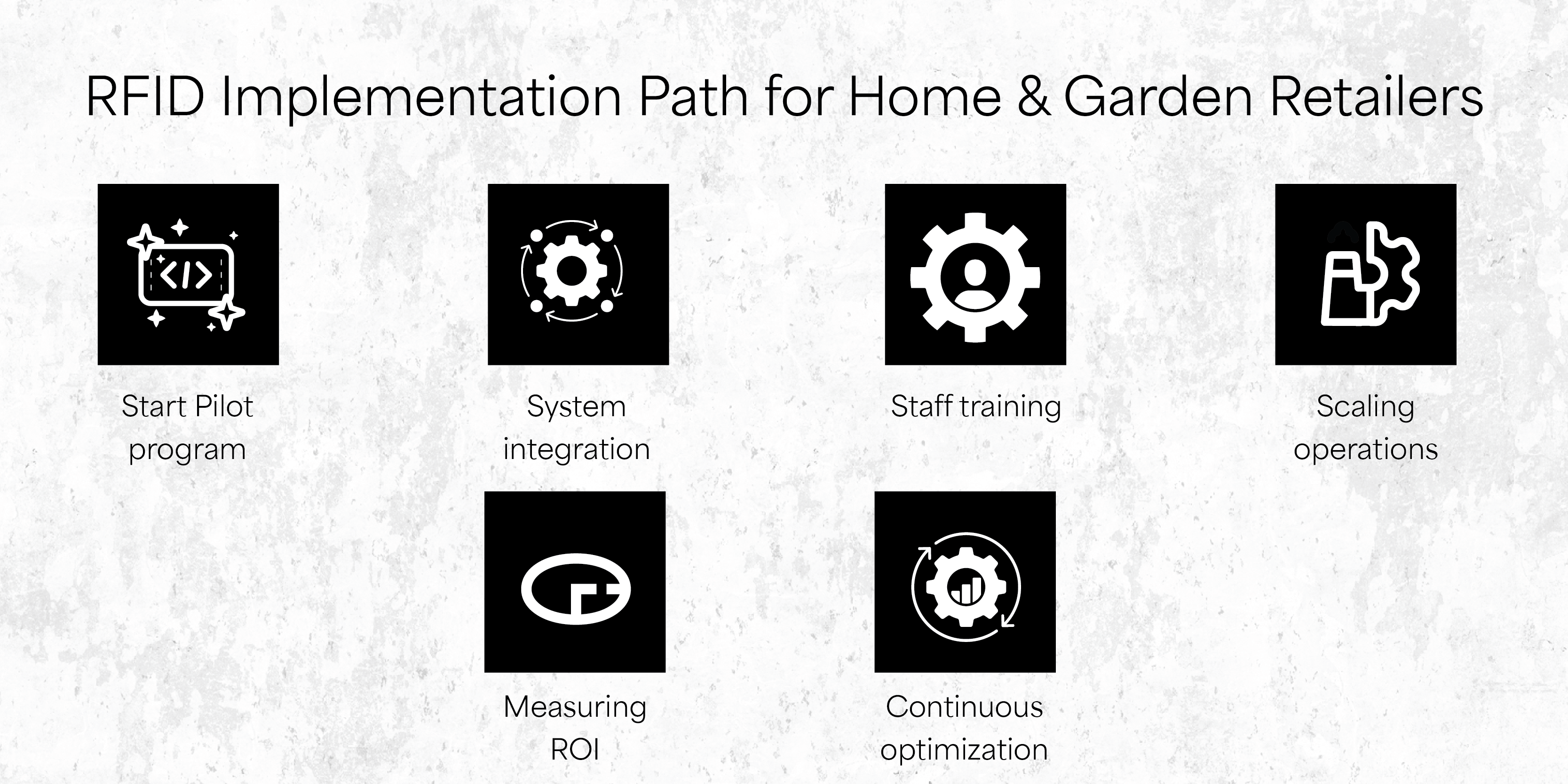
- Pilot program: Begin with a small-scale RFID rollout in one category to test effectiveness, identify challenges, and measure improvements before wider adoption.
- System integration: Connect RFID with POS and e-commerce platforms to enable seamless data flow, real-time visibility, and automated inventory updates across channels.
- Staff training: Educate employees on RFID tools and workflows to ensure smooth adoption, reduce errors, and maximize operational efficiency.
- Scaling operations: Expand RFID implementation gradually across warehouses and retail outlets, ensuring consistent performance and minimizing disruption.
- Measuring ROI: Track improvements in accuracy, shrinkage reduction, and sales growth to evaluate long-term impact and justify continued investment.
- Continuous optimization: Regularly review performance data, adjust workflows, and refine processes to maximize RFID’s benefits over time.
Conclusion
RFID is more than a technology upgrade — it’s a strategic investment. By improving inventory accuracy, reducing shrinkage, and enhancing customer experience, home & garden retailers can combat declining sales and position themselves for long-term growth. Now is the time to embrace RFID and transform retail operations.
Recent Posts
-
Comprehensive Comparison of RFID Metal Mount Tags
RFID Metal Mount Tags are engineered to function reliably on metallic surfaces, where standard RFID …Sep 14th 2026 -

RFID Read Range Dropping? 5 Factors & Settings to Fix It
Introduction RFID technology is the backbone of modern retail and business operations. From tracking …Sep 7th 2026 -

Comprehensive Guide to Troubleshooting RFID Handheld Readers
RFID handheld readers are critical tools for inventory management, asset tracking, and logistics. Wh …Aug 19th 2026