
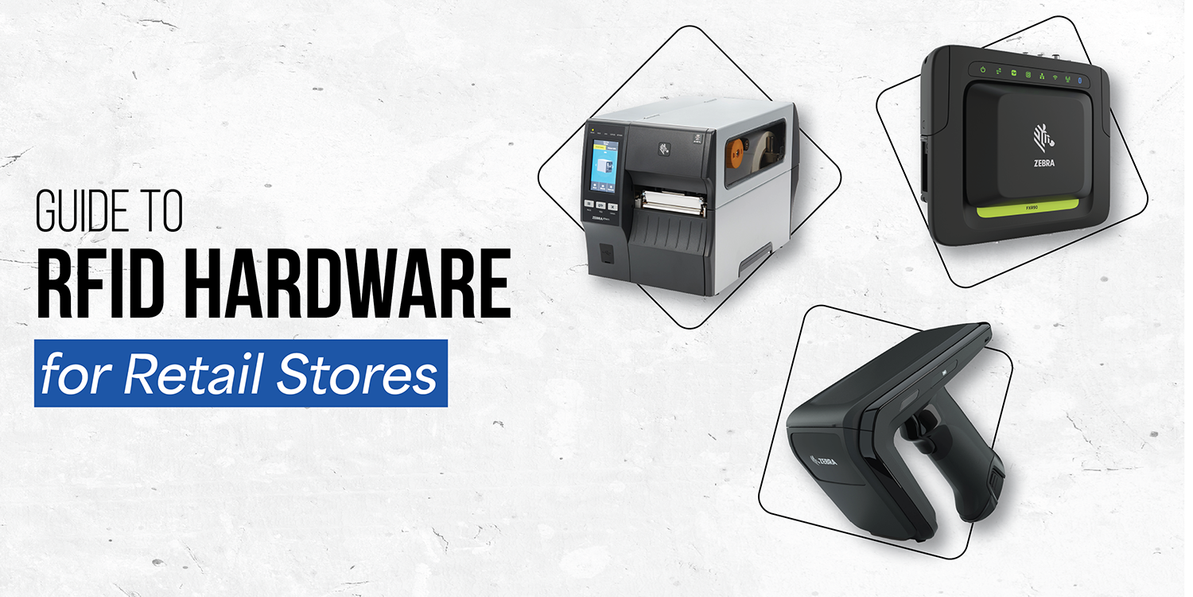
Guide for RFID Hardware for Retail Stores
RFID has become a cornerstone technology in modern retail, enabling real-time visibility, streamlined operations, and enhanced customer experiences. Implementing RFID hardware in retail stores requires a clear understanding of the components, their functions, and how they integrate into daily operations. Below is a comprehensive, long-form guide that covers everything retailers need to know.
What is RFID technology?
RFID (Radio Frequency Identification) is a system that uses electromagnetic fields to automatically identify and track tags attached to objects. Unlike barcodes, which require line-of-sight scanning, RFID labels can be read remotely and simultaneously in bulk.
How it works:
- Each RFID tag contains a microchip and antenna. The reader transmits radio waves that power passive tags. The tag responds with its stored data (e.g., product ID, SKU, batch number).
Why it matters in retail:
- Traditional barcodes require manual scanning, slowing down inventory checks. RFID allows hundreds of items to be scanned in seconds, enabling real-time visibility of stock.
Core RFID Hardware Components in Retail
| Component | Description | Retail Use Case (Detailed) |
|---|---|---|
| RFID labels | Tiny chips with antennas. Types: Passive (no battery, powered by the reader signal). | Apparel: Sewn-in fabric tags. Electronics: Hard tags resistant to interference. Grocery: Specialized tags for liquids/metal packaging. |
| RFID Readers | Emit radio signals and capture tag responses. Handheld readers are mobile and used for cycle counts. Fixed readers are mounted at doors, shelves, or checkout points. | Handheld: Staff can walk aisles and scan hundreds of items in minutes. Fixed: Detect unpaid items leaving the store or track movement between the stockroom and the sales floor. |
| RFID Antennas | Essential for transmitting/receiving signals. Placement determines coverage area. | Entrance antennas: Detect theft. Shelf antennas: Monitor product movement. Fitting room antennas: Enable smart mirrors and personalized recommendations. |
| Middleware & Software | Acts as the connecting hardware to business systems. Provides dashboards, analytics, and integration with POS/ERP. | Example: A dashboard showing real-time stock levels, alerts for shrinkage, and automated replenishment triggers. |
| Printers & Encoders | Encode product data onto blank RFID labels. Often used in warehouses or backrooms. | Example: Printing RFID labels for new shipments before placing them on shelves. |
Applications of RFID Hardware in Retail
- Inventory Management
- RFID enables 95–99% accuracy, compared to 60–70% with barcodes.
- Retailers use RFID to know exactly what’s in stock, reducing lost sales due to stockouts.
- Example: A store manager can instantly check if a size/color is available without searching manually.
- Loss Prevention
- Fixed readers at exits detect unpaid items.
- Unlike traditional EAS (Electronic Article Surveillance), RFID can identify the exact item stolen.
- Example: If a jacket is left unpaid, the system knows the SKU, size, and color.
- Customer Experience
- Smart fitting rooms: RFID fixed readers detect items brought in and suggest accessories or sizes.
- Example: A customer trying on jeans sees a screen suggesting matching tops.
- Supply Chain Efficiency
- RFID tracks goods from the warehouse to the shelf.
- Example: A shipment scanned at receiving automatically updates inventory, reducing manual entry errors.
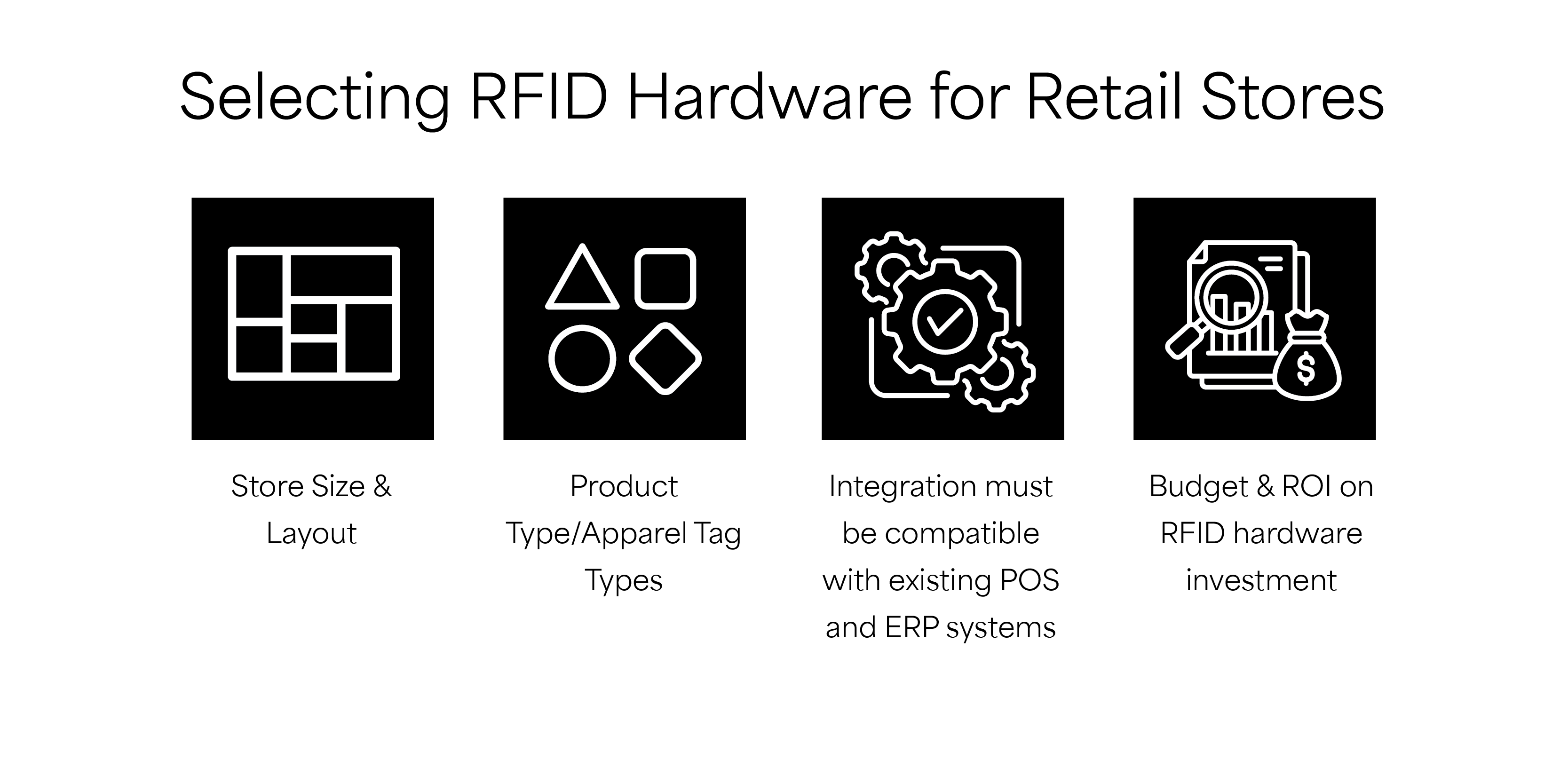
Selecting RFID Hardware for Retail Stores
Architectural Strategy: Store Size & Layout
The physical environment dictates the interrogation zone—the area where tags are energized and read. Selecting the correct reader is a balance between coverage requirements and aesthetic integration.
Store Size & Layout
-
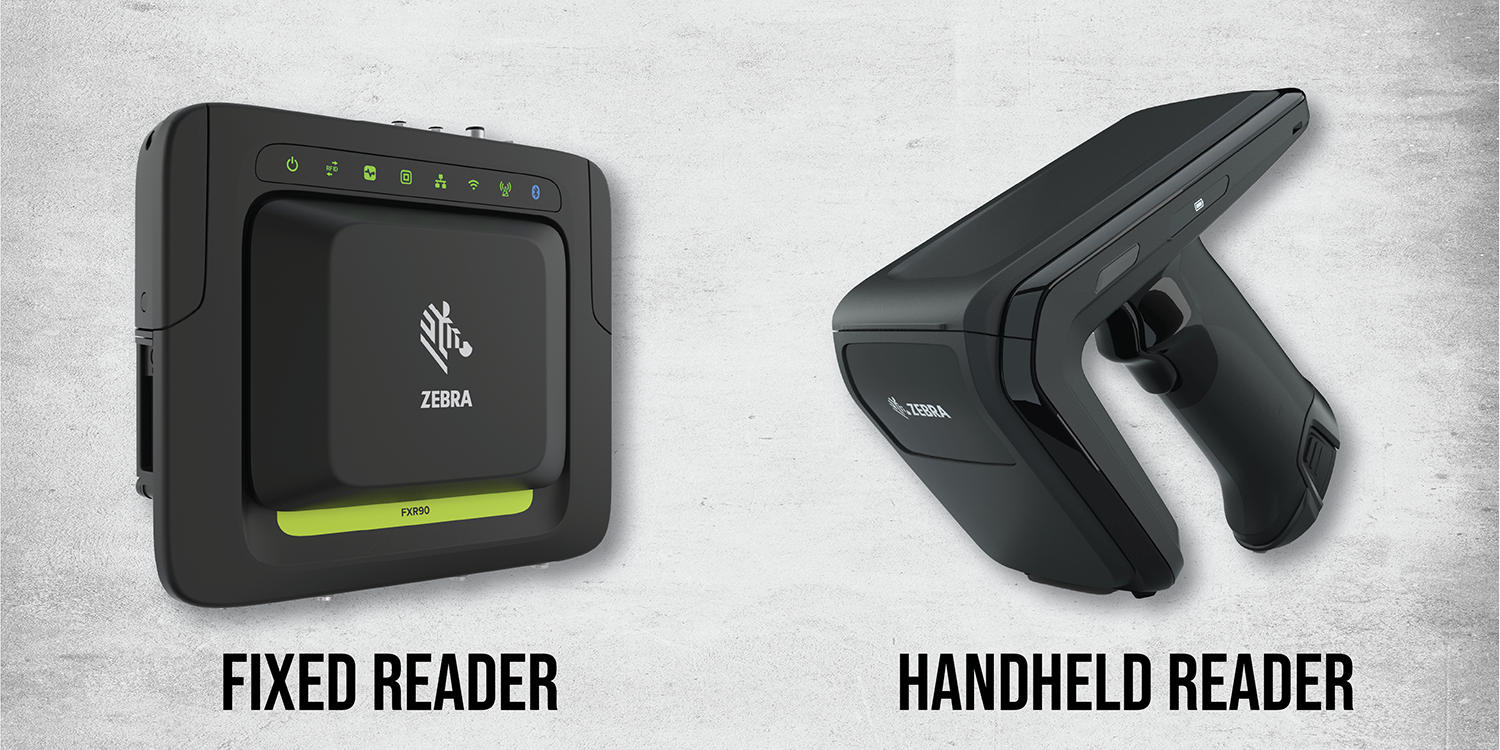
- Small retailers: Can rely on handheld readers for flexibility. Different handheld RFID readers from Zebra: TC22R, Zebra RFD40, Zebra RFD9090, and MC3300XR.
- Large stores: Usually start with handhelds but may expand our to fixed readers and multiple antennas for coverage.Different types of fixed readers from Zebra and Impinj: Zebra FXR90, Zebra FX9600, and Zebra FX7500. Impinj fixed reader Impinj R700.
High-Velocity & Large-Scale Environments (Fixed Infrastructure)
Fixed readers provide autonomous, "always-on" monitoring of inventory transitions. They are best utilized at "choke points" such as receiving docks, stockroom-to-floor transitions, and point-of-exit.
- Zebra FXR90: Engineered for industrial-grade durability. With an IP65/67 rating, it is the primary choice for outdoor garden centers, damp warehouses, or high-dust environments where standard electronics would fail.
- Zebra FX9600: Optimized for high-volume data throughput. It is the gold standard for back-of-house operations where hundreds of items must be read simultaneously as they move through a portal.
- Zebra FX7500: A sleek, low-profile reader intended for front-of-house aesthetics. It offers high performance within a smaller footprint, ideal for mounting under counters or within discreet ceiling enclosures.
- Impinj R700: Renowned for superior receive sensitivity. The R700 excels in complex layouts with high ceilings or dense shelving, where picking up "weak" tag signals is critical for 99% accuracy.
Handheld RFID Reader
Handheld readers provide the agility required for cycle counting, "Locate Item" tasks, and rapid price markdowns.
- Zebra TC22R: A cost-effective, smartphone-integrated solution. Ideal for associates who require a lightweight, familiar interface for occasional RFID tasks.
- Zebra RFD40/RFD90 Sleds: These modular attachments transform standard mobile computers into high-performance RFID Handheld readers. The RFD90 is specifically hardened for rugged environments, offering extreme drop specifications.
- Zebra MC3300XR: An integrated, high-performance "gun-style" reader. Its ergonomic trigger and long-range antenna make it the industry standard for full-store weekly cycle counts, where comfort and speed are paramount.
II. Material Physics: Product Type & Tag Selection
RFID performance is heavily influenced by the substrate of the product. Radio waves interact differently with various materials, requiring specialized tag engineering.
Product Type and RFID Labels Selection
-
- Apparel: Fabric-friendly tags.
- Electronics: On-metal RFID tags designed to avoid interference from metal.
- Liquids: Specialized tags to counter signal absorption.
| Category | Challenge | Technical Solution |
|---|---|---|
| Apparel | Flexibility & Comfort | Inlay/Hang-labels: Standard UHF tags optimized for high-density stacking without "detuning." |
| Electronics | RF Reflection (Metal) | On-Metal Tags: prevent the metal surface from shorting the tag's antenna. |
| Liquids | RF Absorption (Water) | Flag/Encapsulated Tags: Designed to sit away from the container or tuned to operate despite the presence of moisture. |
Encoding Strategy: Industrial vs. Desktop
RFID Printer: If you have to print and encode lots of tags, then choose the Industrial RFID Printer and print a quantity of tags less than choose the RFID desktop reader.
- Industrial RFID Printers (e.g., Zebra ZT411): Necessary for high-volume tagging at the source or distribution center. These units are built for high-duty cycles and precise encoding of complex EPC memory banks.
- Desktop RFID Printers (e.g., Zebra ZD621R): Best suited for "on-demand" tagging at the store level—for example, re-tagging a returned item or marking down clearance stock.
Systems Synthesis: Integration & Data Flow
RFID hardware only delivers value when it is woven into the digital fabric of the enterprise.
- ERP & WMS Sync: Real-time integration ensures that as soon as a fixed reader at the dock door "sees" a shipment, the Enterprise Resource Planning (ERP) system acknowledges the receipt, eliminating manual data entry errors.
- POS Interoperability: An RFID-enabled Point of Sale allows for the simultaneous scanning of an entire basket. This not only accelerates throughput but also ensures the specific item ID is marked as "sold" in the database, preventing false alarms at Electronic Article Surveillance (EAS) gates.
- Omnichannel Accuracy: By maintaining near-perfect inventory accuracy, retailers can confidently offer BOPIS (Buy Online, Pick Up In-Store), significantly reducing the "cancelled order" rate caused by ghost inventory.
Budget & ROI
While the initial CapEx for RFID is higher than that of barcode systems, the OpEx savings and top-line growth provide a compelling return on investment.
- Labor Optimization: Transitioning from a 10-person manual count to a 1-person RFID count reallocates staff toward customer-facing, value-add activities.
- Shrinkage Mitigation: RFID provides granular visibility into "last seen" locations, allowing loss prevention teams to identify patterns of theft or administrative error with surgical precision.
- Revenue Lift: By ensuring the right product is on the right shelf at the right time, retailers typically see a 3% to 8% increase in overall sales due to reduced "out-of-stock" scenarios.
Benefits of RFID Hardware in Retail
- Inventory Accuracy: 95–99% accuracy ensures shelves are stocked correctly.
- Operational Efficiency: Cycle counts that used to take hours now take minutes.
- Sales Growth: Better availability means fewer missed sales opportunities.
- Data-Driven Insights: Real-time analytics help forecast demand and optimize merchandising.
Challenges and Risks
- Interference Issues: Metal shelves and liquids can distort signals.
- Change Management: Staff must adapt to new workflows, and staff training is important.
Implementation Roadmap of RFID in Retail
- Pre-Assessment
- Evaluate current inventory processes, pain points, and goals.
- Example: Identify frequent stockouts or areas with high shrinkage.
- Hardware Selection
- Choose RFID labels, RFID readers (RFID handheld reader and RFID fixed reader), and antennas based on store needs.
- Example: An apparel store may prioritize RFID handheld readers, and an electronics store may need RFID-fixed readers.
- RFID Software Integration
- Connect the RFID retail software with the ERP for seamless data flow with an API.
- Example: Automatic stock updates when items are sold.
- Pilot Testing
- Start small—one department or store section.
- Example: Test RFID in footwear before expanding to apparel.
- Staff Training
- Train employees on RFID workflows, handheld reader use, and troubleshooting.
- Example: Staff learn to conduct cycle counts with handheld devices.
- Scaling
- Expand across stores and integrate with the supply chain.
- Example: Roll out RFID across all branches after a successful pilot.
Summary
RFID hardware transforms retail by boosting accuracy, efficiency, and customer satisfaction. While challenges exist, a structured roadmap ensures smooth adoption. Retailers who invest wisely in RFID gain a competitive edge through real-time visibility and smarter operations.
Recent Posts
-
Comprehensive Comparison of RFID Metal Mount Tags
RFID Metal Mount Tags are engineered to function reliably on metallic surfaces, where standard RFID …Sep 14th 2026 -

RFID Read Range Dropping? 5 Factors & Settings to Fix It
Introduction RFID technology is the backbone of modern retail and business operations. From tracking …Sep 7th 2026 -

Comprehensive Guide to Troubleshooting RFID Handheld Readers
RFID handheld readers are critical tools for inventory management, asset tracking, and logistics. Wh …Aug 19th 2026