
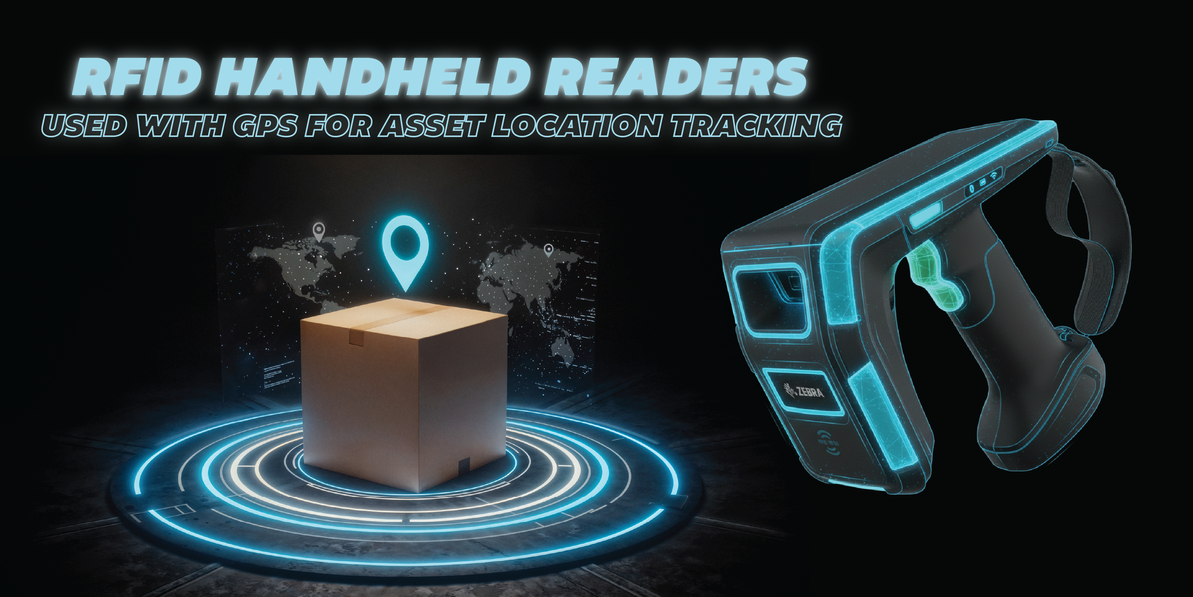
How RFID Handheld Readers Can Be Used with GPS for Asset Location Tracking
Asset tracking has become a critical challenge across industries such as logistics, warehousing, healthcare, and retail. Organizations often struggle with misplaced equipment, inefficient audits, and a lack of visibility into asset movement. Traditional methods like manual logs or barcode scanning provide limited insights, especially when assets move across large geographies or between facilities.
To address these challenges, combining RFID (Radio Frequency Identification) with GPS (Global Position System) offers a powerful solution. RFID provides identity and data about assets, while GPS delivers real-time location coordinates through an RFID Handheld Reader. Together, they enable organizations to achieve complete visibility into both what an asset is and where it is located.
Basics of RFID and GPS in Asset Tracking
RFID (Radio Frequency Identification)
- Uses tags embedded with microchips that store unique IDs and data.
- Readers scan these tags wirelessly, eliminating the need for line-of-sight scanning like barcodes.
- Provides fast identification of multiple assets simultaneously.
- Can store additional information such as maintenance history, ownership, or usage details.
GPS (Global Positioning System)
- A satellite-based navigation system that provides geographical coordinates (latitude, longitude, altitude).
- Enables outdoor location tracking with accuracy ranging from 3–10 meters, depending on conditions.
- Widely used in fleet management, navigation, and logistics.
Integration Concept
- RFID identifies what the asset/item is.
- GPS identifies where the asset/item is.
- Together, they provide complete visibility, enabling organizations to track identity and location in real time.
Role of GPS in Location Tracking
GPS technology plays a vital role in outdoor asset tracking.
- Accuracy Levels: Consumer-grade GPS devices typically offer 5–10 meters accuracy, while advanced differential GPS systems can achieve sub-meter precision.
- Benefits: Real-time monitoring of assets across geographies, route optimization for logistics, and improved accountability.
- Limitations: GPS signals weaken indoors, underground, or in dense urban environments. This makes GPS alone insufficient for comprehensive asset tracking, especially in warehouses or hospitals.
Role of RFID Handheld Readers with GPS
RFID handheld readers are portable devices that scan RFID tags. When integrated with GPS, they capture both the asset’s identity and its location coordinates simultaneously.
Key Features:
- Portable and rugged design for field use.
- Ability to scan multiple tags quickly.
- GPS-enabled RFID readers record the exact location at the time of scan.
- Data can be transmitted to asset management software for visualization.
Use Cases of RFID And GPS Together:
- Field Service Teams: Technicians can track tools and equipment across service sites.
- Logistics Companies: Monitor shipments during transit and confirm delivery locations.
- Healthcare Facilities: Track mobile medical devices such as wheelchairs, infusion pumps, or portable scanners.
Examples of GPS-Enabled RFID Handheld Readers
These devices demonstrate how RFID handheld readers can be tailored to different industries and budgets.
|
Device |
Features |
Industry Use |
|
Integrated UHF RFID + GPS, rugged design, long battery life |
Logistics, warehousing, outdoor asset tracking |
|
|
Zebra 9090 with TC53/T58 |
Compact, GPS-enabled option, cost-effective |
Retail, supply chain, mid-sized businesses |
|
Bluetooth RFID sled for smartphones/tablets |
Field mobility, scalable for BYOD environments |
|
|
1,300+ tags/sec, Bluetooth® 5.3, 7,000 mAh battery, rugged IP54 design |
Logistics, healthcare, retail, and high-volume inventory audits |
|
|
Zebra RFD40 With TC53 |
Identity + Location: RFID sled captures asset identity, while TC53 provides GPS coordinates. |
Logistics, warehousing, and outdoor asset tracking |
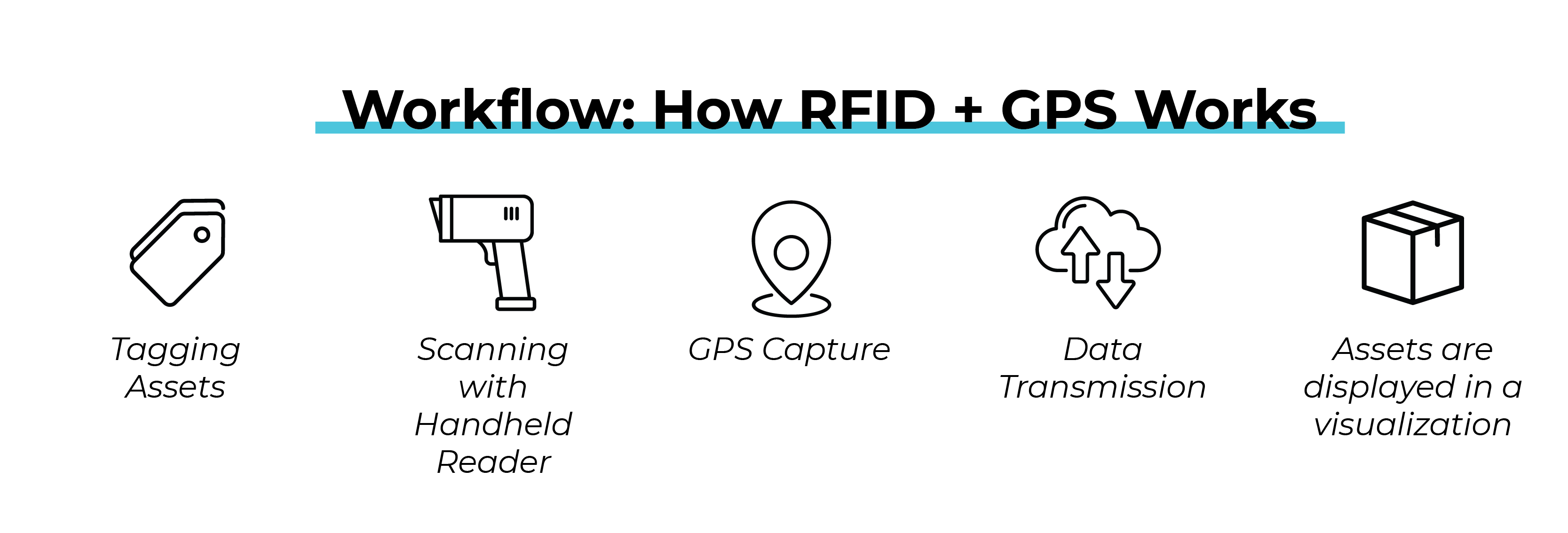
Workflow: How RFID + GPS Works in Practice
- Tagging Assets: Assets are tagged with RFID labels containing unique IDs.
- Scanning with Handheld Reader: The operator scans the tag using the RFID handheld reader.
- GPS Capture: The device records GPS coordinates at the time of scan.
- Data Transmission: Information is sent to asset management software via Wi-Fi, cellular, or Bluetooth.
- Visualization: Assets are displayed on a digital map with both identity and location.
This workflow ensures that organizations know not only what assets they own but also where they are located at any given time.
Key Benefits of Using RFID Handheld Readers with GPS
- Operational Efficiency: Faster audits and inventory checks compared to manual methods.
- Real-Time Visibility: Track assets across warehouses, vehicles, and outdoor sites.
- Loss Prevention: Immediate identification of misplaced or stolen assets.
- Scalability: Applicable across industries, including logistics, healthcare, retail, and construction.
- Data Accuracy: Reduces human error and ensures reliable asset records.
Industry Applications
- Logistics & Supply Chain: Shipment tracking across geographies, ensuring timely delivery and reducing theft.
- Healthcare: Monitoring medical equipment movement between facilities, improving patient care efficiency.
- Construction: Tracking tools and machinery across multiple sites, reducing downtime and misplacement.
- Retail: Managing mobile assets and stock movement, ensuring accurate inventory and reducing shrinkage.
Challenges and Considerations
While RFID + GPS integration offers significant advantages, organizations must consider:
- Signal Limitations: GPS accuracy may vary indoors; hybrid solutions with Wi-Fi or BLE may be needed.
- Battery Life: GPS and RFID scanning consume power, requiring efficient battery management.
- Data Integration: Requires robust asset management software capable of handling large datasets.
- IT Infrastructure: Integration with ERP, WMS, or healthcare IT systems is essential for seamless operations.
Conclusion
RFID handheld readers with GPS provide a powerful solution to asset tracking challenges across industries. By combining RFID’s ability to identify assets with GPS’s ability to locate them, organizations gain real-time visibility, operational efficiency, and loss prevention.
Devices such as the Chainway C72, Zebra 9090 with EM45, and CSL CS108 RFID Sled demonstrate practical implementations of this technology.
For businesses seeking smarter asset management, adopting RFID + GPS solutions is no longer optional—it is a necessity for efficiency, accountability, and scalability in today’s competitive environment.
Recent Posts
-

RFID Mobile Computer vs Sled Reader: Which Should You Choose?
RFID technology has become a game‑changer in retail, logistics, and asset tracking. It helps busines …Apr 7th 2026 -

How RFID Handheld Readers Can Be Used with GPS for Asset Location Tracking
Asset tracking has become a critical challenge across industries such as logistics, warehousing, hea …Feb 26th 2026 -
How to Choose the Best RFID Printer: A Complete Buyer's Guide
1. What is an RFID Printer (and Why Do You Need One)? An RFID (Radio Frequency Identification) print …Feb 17th 2026