
Why Add RFID to Your Labeling Strategy in 2026
In 2026, the global supply chain is undergoing a seismic transformation. From omnichannel retail to Industry 4.0 manufacturing, the demand for real-time visibility, automation, and data-driven decision-making has never been higher. At the heart of this transformation lies a deceptively simple yet powerful tool: the label.
But not just any label—RFID-enabled labels are redefining what labeling means in the modern enterprise. No longer just static identifiers, labels are becoming intelligent data carriers that bridge the physical and digital worlds. This article explores why integrating Radio Frequency Identification (RFID) into your labeling strategy is not just a technological upgrade—it's a strategic imperative for 2026 and beyond.
Section 1: The Limitations of Traditional Labeling
Before diving into RFID, it's essential to understand the constraints of conventional labeling methods like barcodes and QR codes:
- Line-of-Sight Dependency: Barcodes require direct visual access to be scanned, limiting automation.
- Manual Labor: Scanning each item individually is time-consuming and error-prone. This is also very labor intensive which usually means expensive!
- Limited Data Capacity: Barcodes store minimal information, often just a product ID.
- No Real-Time Tracking: Once scanned, the item’s status becomes static until the next scan.
- Susceptibility to Damage: Labels can be smudged, torn, or rendered unreadable.
These limitations create bottlenecks in inventory management, shipping, receiving, and compliance—especially in high-velocity environments like retail, healthcare, and logistics.
Section 2: What Is RFID Labeling?
RFID uses electromagnetic fields to identify and track tags attached to objects automatically. An RFID label typically consists of:
- An RFID chip: Stores unique data (e.g., EPC, serialized ID, sensor data).
- An RFID antenna: Transmits data to RFID readers.
- A substrate: The physical label material (paper, plastic, or synthetic).
Unlike barcodes, RFID tags do not require line-of-sight and can be read in bulk, even through packaging or containers.
Section 3: Why 2026 Is the Tipping Point for RFID Labeling
Several macro and micro trends are converging to make 2026 the ideal year to adopt RFID in your labeling strategy:
1. Cost Reduction and Scalability
- RFID tag prices have dropped for high-volume orders.
- We now offer pre-encoded, pre-printed RFID labels, reducing deployment friction.

2. Regulatory and Retail Mandates
- Major retailers (e.g., Walmart, PVH, Decathlon) are expanding RFID mandates to new product categories.
- Pharmaceutical and food industries face stricter traceability and serialization requirements.
3. IoT and Digital Twin Integration
- RFID labels are foundational to digital twin strategies, enabling real-time asset mirroring.
- Integration with IoT platforms allows for predictive analytics, condition monitoring, and automation.
4. Sustainability and Circular Economy
- RFID enables reverse logistics, reusable packaging, and waste reduction by improving asset visibility.
- Paper-based RFID tags and eco-friendly inlays support ESG goals.
Section 4: Strategic Benefits of RFID-Enabled Labeling
1. Real-Time Inventory Accuracy
- Achieve 99%+ inventory accuracy with passive UHF RFID.
- Reduce out-of-stocks, overstocks, and shrinkage.
2. Faster Throughput and Labor Efficiency
- Scan hundreds of items in seconds—no line-of-sight required.
- Reduce manual scanning time by up to 90% in receiving, picking, and shipping.
3. Enhanced Traceability and Compliance
- Track items from source to shelf with item-level serialization.
- Meet ISO, SOC regulations with minimal manual intervention.
4. Improved Customer Experience
- Enable BOPIS (Buy Online, Pick Up In Store) and same-day fulfillment with accurate stock visibility.
- Reduce returns and improve satisfaction with better product availability.
5. Data-Driven Decision Making
RFID labels generate granular, time-stamped data for:
- Demand forecasting
- Loss prevention
- Space optimization
- Vendor performance analysis
Section 5: Key Components of an RFID Labeling Strategy
To successfully integrate RFID into your labeling ecosystem, consider the following pillars:
- Label Selection
- Material: Paper (short-term), synthetic (durable), or on-metal (for metallic surfaces).
- Form Factor: Inlays, hang tags, wrap labels, or embedded tags.
- Frequency: UHF
- Encoding and Printing
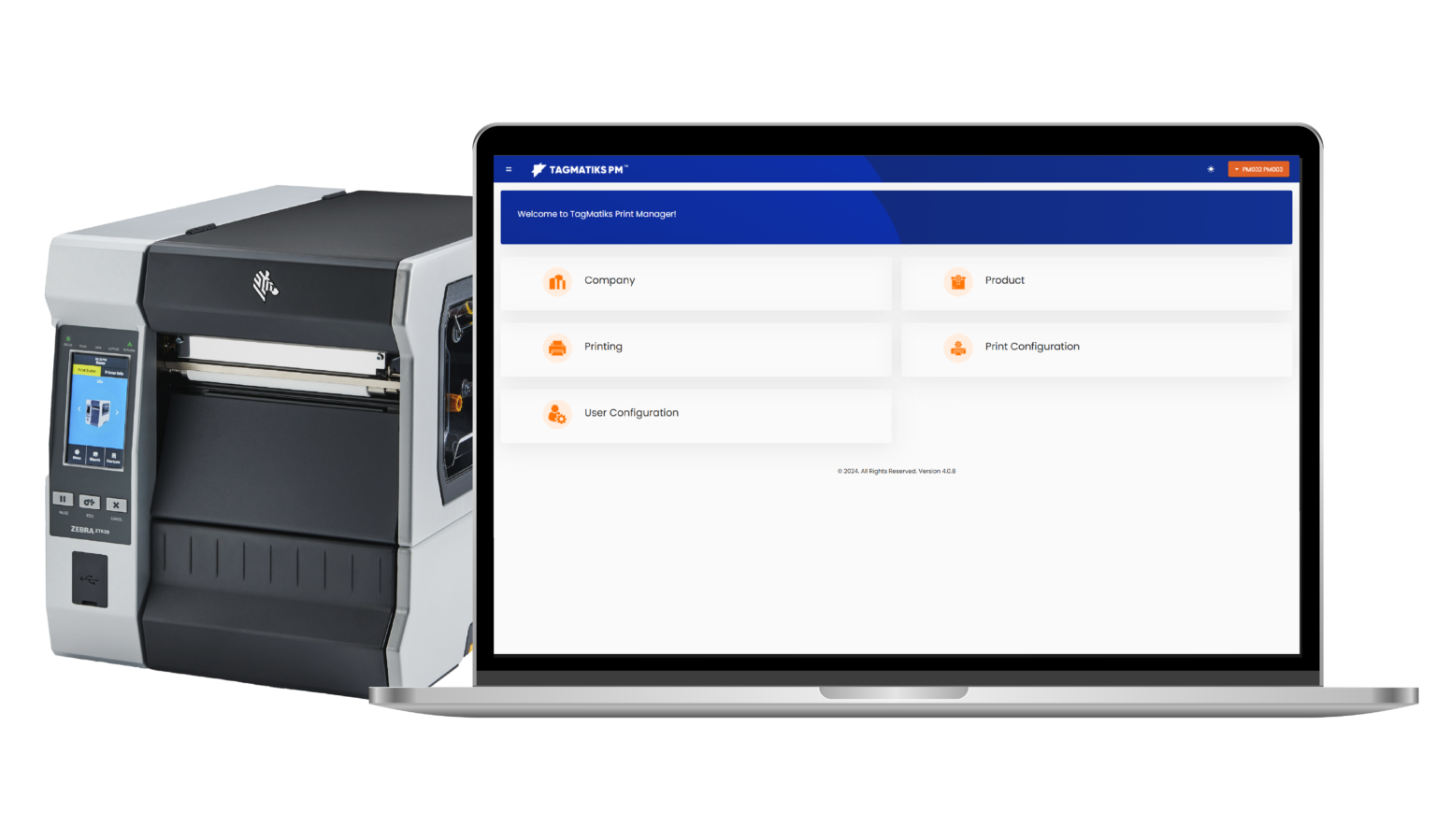
- Use RFID printers (TagMatiks PM) to encode EPCs and print human-readable info.
- Consider cloud-based encoding services for scalability and compliance.
- Data Standards and Serialization
- Adopt GS1 EPCglobal standards for interoperability.
- Implement unique item-level serialization for traceability and analytics.
- Middleware and Integration
- Use RFID middleware (TagMatiks Core) to filter, aggregate, and route tag reads.
- Integrate with ERP, WMS, MES, and POS systems for end-to-end visibility.
- Reader Infrastructure
- Deploy fixed readers at dock doors, conveyors, and portals.
- Use handheld readers for cycle counts, audits, and exception handling.
Section 6: Use Cases Across Industries:
Retail
- Item-level tagging for apparel, footwear, cosmetics, and electronics.
- Smart fitting rooms, self-checkout, and check-in.
Healthcare
- Track medical devices, surgical kits, and pharmaceuticals.
- Ensure cold chain compliance and reduce expired inventory.
Manufacturing
- WIP (Work-in-Progress) tracking on assembly lines.
- Tool tracking and preventive maintenance.
Logistics and Warehousing
- Cross-docking, pallet tracking, and automated shipping verification.
- Yard management and returnable transport item (RTI) tracking.
Section 7: Overcoming Common Challenges
1. Cost Justification
- ROI is typically achieved within 8–18 months through labor savings and shrink reduction.
- Start with pilot projects in high-impact areas (e.g., high-value SKUs, high-volume lanes).
2. Label Compatibility
- Use on-metal RFID tags for IT assets or metallic surfaces.
- Choose printable RFID labels that match existing form factors.
3. Reader Calibration and Interference
- Conduct site surveys to optimize antenna placement and read zones.
- Use shielding boxes or tunnels to isolate reads in dense environments.
4. Data Overload
- Implement middleware filters and event-based triggers to manage read events.
- Align data capture with business rules (e.g., read-on-exit only).
By 2026 and beyond, RFID labels will evolve into multi-sensor smart labels capable of:
- Temperature, humidity, and shock sensing
- Blockchain integration for immutable supply chain records
- AI-driven analytics for predictive inventory and demand planning
The convergence of RFID with 5G, edge computing, and AI will unlock new levels of automation and intelligence across industries.
Conclusion: From Labels to Leverage
In 2026, adding RFID to your labeling strategy is not just about tracking—it’s about transforming your operations, unlocking real-time visibility, and future-proofing your business. Whether you're in retail, healthcare, logistics, or manufacturing, RFID labels offer a scalable, standards-based path to operational excellence.
Recent Posts
-
How RFID Handheld Readers Can Be Used with GPS for Asset Location Tracking
Asset tracking has become a critical challenge across industries such as logistics, warehousing, hea …Feb 26th 2026 -
How to Choose the Best RFID Printer: A Complete Buyer's Guide
1. What is an RFID Printer (and Why Do You Need One)? An RFID (Radio Frequency Identification) print …Feb 17th 2026 -
Zebra RFD40-M Premium Plus UHF RFID Sled
The Zebra RFD40M Premium Plus UHF RFID Sled is a modular, high-performance RFID reader that attaches …Feb 9th 2026